


7 Shocking Ways Applying Oil Directly onto Dry Hair Makes It Brittle
When applying oil directly onto dry hair makes it brittle, many people feel confused and frustrated. You coat your strands hoping for softer, shinier, healthier locks. Instead, your ends stay rough, your frizz multiplies, and your hair snaps with subtle tension.
Hair oiling is a cherished traditional practice across generations. From rich coconut oil scalp massages to lightweight modern finishing serums, oils enhance manageability and surface gloss.
However, many people confuse lubrication with actual hydration. Oil creates a hydrophobic seal on the hair shaft, but it does not add water or repair underlying structural damage.
When you apply oil over dehydrated hair without conditioning or proper cleansing, moisture gets locked out entirely. Understanding why applying oil directly onto dry hair makes it brittle helps you adjust your routine to protect fragile strands.
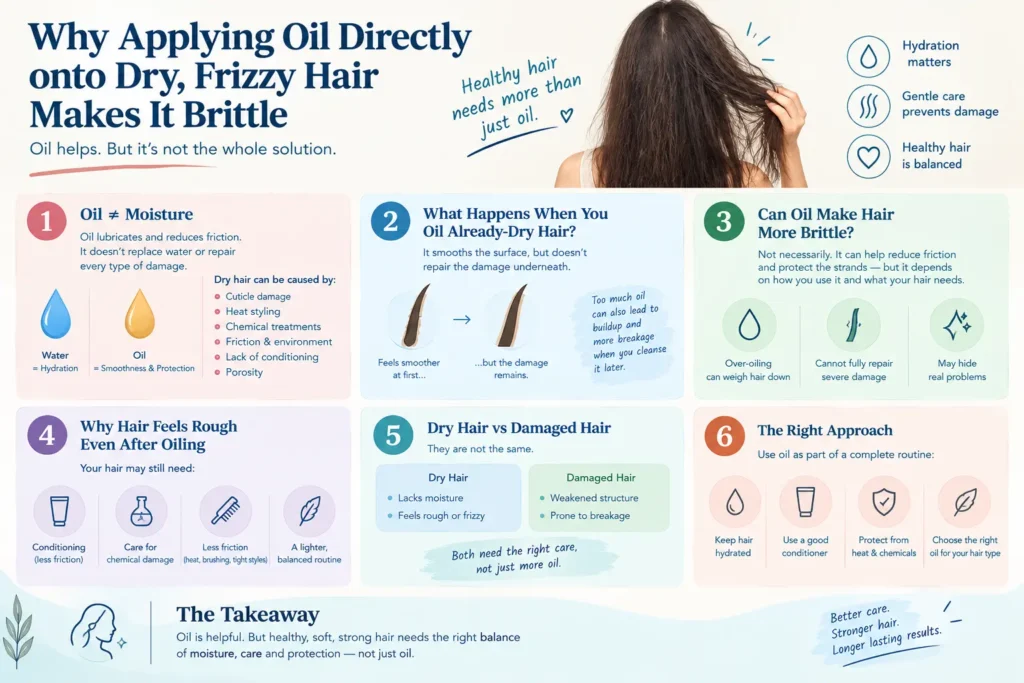
1. The Biggest Haircare Myth: Oil Equals Moisture
A widespread mistake in haircare is assuming dry hair simply needs more oil.
Oil and water perform completely different functions for your hair shaft. Water provides essential internal hydration, whereas oils offer surface lubrication, cuticular smoothing, and sealants to minimize moisture loss.
Your visible hair shaft consists of dead keratinized proteins. Unlike skin, hair cannot produce natural moisturizing factors to repair itself.
Common Causes of Rough, Dehydrated Hair:
Cuticular abrasion from frequent heat styling
Chemical coloring and bleaching treatments
Constant mechanical friction from brushing and rough towels
Porous hair structures that release moisture rapidly
Applying heavy oils over dehydrated hair conceals surface damage temporarily, but it fails to supply the structural hydration your strands require.
2. What Happens When You Apply Oil to Dry Hair?
Imagine applying varnish directly over cracked, dusty wood without sanding or dampening it first. The outer coating appears shiny initially, but the internal structure remains brittle underneath.
A similar reaction happens when you coat dehydrated hair strands with pure plant oils.
The oil film reduces friction and adds superficial shine. However, if your hair cuticle is weather-damaged, the compromised core receives no genuine repair.
While your hair looks glossier right after application, it often feels rough and stiff again once washed. Surface smoothness is completely different from internal structural strength.
Over-oiling dry hair also builds up heavy residue, forcing you to scrub aggressively during shampooing, which leads to mechanical breakage.
3. How Applying Oil Directly onto Dry Hair Makes It Brittle
So, why does applying oil directly onto dry hair makes it brittle over time? While oil itself does not destroy hair proteins, incorrect application creates severe indirect damage:
    [ Dry, Unhydrated Hair Shaft ]
                  │
                  ▼
   [ Coated with Heavy Plant Oil ]
                  │
                  ▼
 [ Environmental Water Blocked Out ]
                  │
                  ▼
  [ Repeated Washing & Harsh Scrubbing ]
                  │
                  ▼
 [ Structural Stiffness & Snapping Hair ]
1. Excessive Buildup Causes Mechanical Strain
Heavy oils weigh down dry strands, making them sticky and prone to tangling. Removing thick oil buildup requires repeated shampooing, which strips away natural lipids and causes friction-induced snapping.
2. Failure to Seal Actual Hydration
Oils act as occlusives. When applied to completely dry, low-moisture hair, oil creates a waterproof barrier that prevents ambient humidity from conditioning the hair shaft, leaving it stiff and prone to breaking.
3. Masking Severe Cuticle Breakdown
Oil imparts temporary gloss over split ends and broken cuticles, giving a false appearance of health. Ignoring structural damage delays necessary trims and targeted conditioning treatments.
To learn more about hair anatomy and cuticle health, explore research at the National Center for Biotechnology Information or review expert guides on WebMD.
4. Why Your Hair Feels Rough Even After Oiling
If your hair stays frizzy despite regular oiling, several underlying factors may be at play:
Lack of Rinse-Out Conditioners: Conditioners use cationic surfactants to smooth cuticles and eliminate static friction, which pure oils cannot achieve on their own.
Chemical and Thermal Stress: Bleached or heat-damaged hair develops porous gaps that require protein reconstructors and humectants, not just lipid coatings.
Aggressive Handling: Rough towel-drying, tight hairstyles, and detangling without slip cause physical micro-tears along hair shafts.
Overloaded Product Layers: Stacking heavy waxes, butter creams, and oils builds up residue, leaving hair feeling stiff, coated, and straw-like.
5. The Critical Difference Between Dry Hair and Damaged Hair
Understanding whether your hair is dry or structurally damaged ensures you choose the right treatments:
Dry Hair Characteristics: Feels rough or straw-like due to weather or harsh soaps, but improves significantly with rinse-out conditioners and leave-in moisture treatments.
Damaged Hair Characteristics: Unusually fragile and prone to snapping off mid-strand due to heat tools, chemical dye, or bleach. It remains rough despite deep conditioning and often requires trimming split ends.
Hair can be both dry and damaged simultaneously. While conditioners restore softness, severely compromised strands need damage-prevention habits and regular trims to regain health.
6. The Right Way to Oil Dry, Frizzy Hair
You do not need to give up oiling entirely. Instead, use oils strategically alongside proper hydration steps:
Pick the Right Oil: Use penetrating oils like coconut oil before washing to minimize protein loss, or lightweight sealing oils like argan oil or jojoba oil on damp ends.
Use Minimal Quantities: Start with a few drops concentrated on your mid-lengths and ends to avoid overloading your hair.
Try Pre-Wash Treatments: Apply coconut oil 30 minutes before shampooing to coat hair strands and reduce water-induced swelling (hygral fatigue).
Condition After Cleansing: Always follow shampoo with a hydrating conditioner to smooth the cuticle and restore elasticity.
Protect Hair from Heat: Apply thermal protectant spray before using hot tools to prevent high-temperature damage.
7. Should You Apply Oil to Wet, Damp, or Dry Hair?
Different application timing yields varying results depending on your hair’s needs:
On Damp Hair: Ideal for sealing in moisture. Applying a few drops of oil over a water-based leave-in conditioner locks in hydration effectively.
On Dry Hair: Best restricted to tiny amounts as a finishing polish to tame flyaways, rather than a deep moisturizing treatment.
Before Washing (Pre-poo): Excellent for minimizing structural damage during shampooing, especially for high-porosity or fragile hair.
Five Common Hair Oiling Mistakes to Avoid
❌ Adding More Oil to Fix Dryness: More oil does not equal hydration. If hair feels rough, add water-based conditioners instead.
❌ Rubbing Oil Aggressively: Rubbing fragile strands together causes friction and breakage. Smooth oil gently down the hair shaft.
❌ Applying Extreme Heat over Oiled Hair: Heating oiled hair with flat irons or hot oil caps can cook the hair fiber, leading to severe damage.
❌ Relying on Oil to Fix Split Ends: Oils cannot mend split ends permanently. Trimming is the only effective solution.
❌ Applying Heavy Oils to an Irritated Scalp: Occlusive oils can worsen scalp conditions like seborrheic dermatitis and dandruff.
Interactive Hair Check: What Does Your Hair Need?
Question 1: How does your hair feel right after oiling?
A) Soft, shiny, and easy to detangle.
B) Shiny initially, but rough and straw-like shortly after.
C) Heavy, sticky, and greasy.
Question 2: What happens when you shampoo your hair?
A) It feels manageable once conditioner is applied.
B) It tangles severely and feels stiff and fragile.
C) My scalp feels itchy or coated with buildup.
What Your Results Mean:
Mostly A: Your routine is balanced. Continue using oils lightly on damp ends alongside regular conditioning.
Mostly B: Applying oil directly onto dry hair makes it brittle when underlying hydration is missing. Switch to water-based leave-in conditioners and use oils sparingly to seal in moisture.
Mostly C: You are over-oiling. Focus on clarifying your scalp and apply lightweight oils only to dry ends.
A Simple Routine for Softer, Less Frizzy Hair
Pre-Wash Stage
Gently detangle hair with a wide-tooth comb.
Apply a small amount of coconut oil to dry lengths as a protective pre-wash treatment.
Washing Stage
Cleanse your scalp gently with a mild shampoo.
Avoid scrubbing your ends aggressively; allow the lather to rinse down naturally.
Post-Wash Stage
Apply a hydrating conditioner to mid-lengths and ends, then rinse thoroughly.
Smooth a water-based leave-in conditioner onto damp hair, followed by 2–3 drops of argan oil to lock in moisture.
Air-dry or blow-dry on low heat settings.
Go Look Takeaway
Understanding why applying oil directly onto dry hair makes it brittle helps you transform your hair care routine. Oil acts as a sealant, not a hydrator. By combining hydrating conditioners, gentle handling, and strategic oil application on damp hair, you can protect your strands from breakage and enjoy soft, manageable, and healthy-looking hair.
