


4 Amazing Secrets to Fix Frizzy Halo Hair Appears Right Near Your Hairline in Hot Humidity
When frizzy halo hair appears right near your hairline in hot humidity, those tiny strands standing around your forehead, the fuzzy hair framing your face, and the stubborn flyaways refuse to stay in place even after styling. Sound familiar?
You step out with perfectly styled hair. Your parting looks neat, your lengths appear smooth, and every strand seems to fall exactly where it should. But within minutes of stepping into Chennai’s heat and humidity, a soft, fuzzy halo begins forming around your hairline.
Suddenly, your hairstyle looks less polished. Tiny strands rise around your forehead, your baby hairs refuse to cooperate, and your carefully styled hair develops a mind of its own.
You smooth it down, apply a little serum, or reach for your hairbrush. The result looks perfect for a moment until the humidity strikes again.
But why does this happen so noticeably around your hairline? Why do these short strands become frizzy even when the rest of your hair appears relatively smooth?
The answer lies in the unique combination of hair structure, new hair growth, moisture absorption, and environmental humidity.
At Go Look, we believe that understanding your hair is the first step towards caring for it effectively. Let’s uncover the science behind halo frizz and discover how to keep those delicate strands looking smoother, healthier, and more manageable.
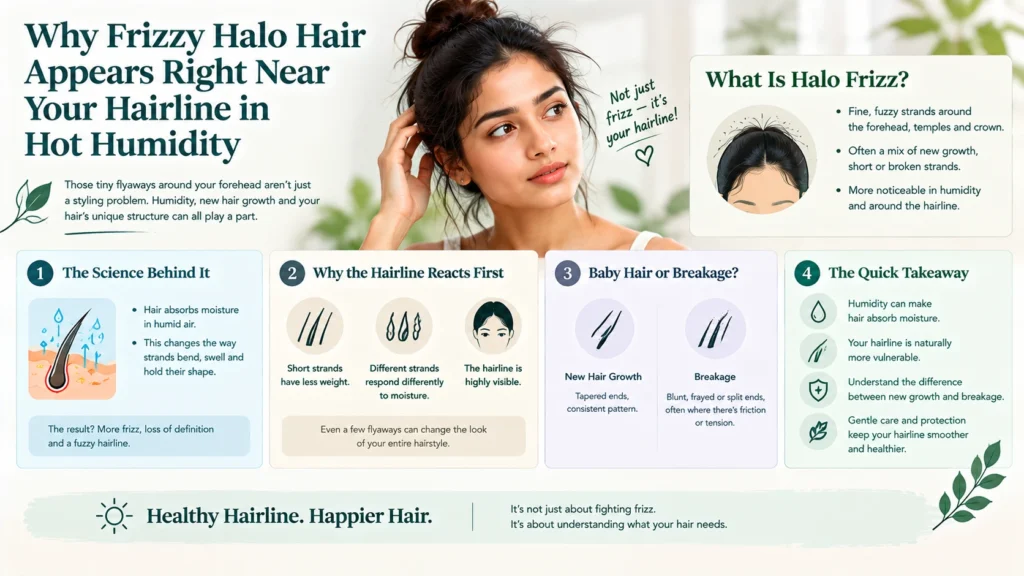
What Exactly Is Halo Frizz?
Halo frizz refers to the fine, fuzzy strands that stand away from the head, creating a soft, uneven outline around your hairstyle.
Alt Text: Frizzy halo hair appears right near your hairline in hot humidity during summer weather
It is particularly noticeable along the forehead, temples, parting, and crown. Unlike frizz that spreads throughout the lengths of your hair, halo frizz often appears concentrated around the top of your head and hairline.
It can affect almost any hair type, although the appearance and severity vary depending on hair texture, strand condition, styling habits, and environmental conditions.
Why does it look like a halo?
The hair around your hairline often contains a mixture of different strand lengths.
Some strands are newly growing hairs. Others may be naturally short, broken, curly, or finer than the rest of your hair. When these strands bend, lift, or separate from the surrounding hair, they become more visible against the background of your hairstyle.
Add humidity to the equation, and the fuzzy outline can become even more pronounced.
The important distinction: Not every strand around your hairline is damaged hair. Some may be completely healthy new growth, while others may be affected by breakage or dryness.
Learning to recognise the difference helps you choose the right hair-care approach.
1. The Humidity Connection: Why Your Hairline Reacts First
Have you ever noticed that your hair behaves beautifully indoors but becomes frizzy almost immediately after stepping outside? Humidity may be the missing piece of the puzzle.
Hair contains a structural protein called keratin. Its shape and behaviour are influenced by the arrangement of bonds within the hair fibre and by its interaction with water. When the surrounding air is humid, hair can absorb moisture from the atmosphere.
This changes the interactions within the hair fibre and can alter the way individual strands bend, swell, and maintain their shape.
For some people, the result is increased frizz, loss of definition, or a hairstyle that becomes difficult to control.
Why is the hairline particularly noticeable?
There are several reasons:
Short strands have less weight: Short hairs around the forehead and temples are often easier to lift and separate than longer strands. Without the weight of longer hair pulling them down, they can stand away from the scalp more visibly.
Different strands respond differently to moisture: New growth, damaged strands, and naturally textured hair may behave differently from the longer hair surrounding them. As humidity changes the shape of individual fibres, these differences become more obvious.
The hairline is highly visible: Even a small number of flyaways can alter the appearance of a sleek hairstyle because they sit directly around the face.
The result is a fuzzy outline that can make otherwise smooth hair appear frizzy.
Remember: Humidity does not automatically mean your hair is unhealthy. Sometimes, your hair is simply responding to its environment.
2. Baby Hair or Breakage? Learn to Read the Difference
Before trying to control halo frizz, it is important to understand what those short strands might actually be. Many people assume that every flyaway is damaged hair. However, the hairline naturally contains shorter strands, and new growth is a normal part of the hair cycle.
At the same time, repeated tension, friction, and heat styling can cause breakage that resembles new growth.
How to distinguish between them:
New Hair Growth: Features short strands emerging consistently along the hairline or parting with naturally tapered ends. This is a normal result of the hair growth cycle and requires gentle care and patience.
Hair Breakage: Features strands of varying short lengths concentrated where friction or tension occurs, with blunt, frayed, or split ends. This stems from excessive heat, tight hairstyles, friction, or chemical damage, requiring reduced manipulation and protective measures.
If you notice a widening part, receding hairline, sudden shedding, or persistent thinning, consult a dermatologist rather than assuming the problem is simply frizz. You can learn more about hair cycle science and follicular health at the American Academy of Dermatology Association or review clinical guides on WebMD.
A quick question for you
Do the tiny strands appear evenly around your hairline, or do you notice more short hairs where you frequently tie your hair tightly?
The first pattern may reflect natural growth, while the second could indicate breakage from repeated tension. Neither pattern alone establishes the cause, but observing your hair can help you identify habits worth changing.
3. Five Reasons Your Hairline Develops a Frizzy Halo
Humidity is often the trigger, but several everyday habits can make halo frizz more noticeable.
A. Your Hair Is Losing Its Smooth Surface
Healthy hair has an outer protective layer called the cuticle, made of overlapping scales. When the cuticle is in good condition, the hair surface tends to feel smoother and reflect light more evenly.
Heat damage, chemical processing, friction, and weathering can compromise the cuticle, making the hair more vulnerable to roughness and breakage. Damaged strands may respond less predictably to humidity and become more difficult to smooth.
What helps? Use a suitable conditioner after shampooing and minimise excessive heat styling. If your hair is chemically treated, consider products formulated for damaged or colour-treated hair.
       [ Damaged Cuticle Layer ]
                   │
                   ▼
  [ High Environmental Moisture Absorption ]
                   │
                   ▼
      [ Hair Fiber Swells & Bends ]
                   │
                   ▼
  [ Frizzy Halo Hair Near Hairline Appears ]
B. Your Hairline Is Experiencing Too Much Friction
Think about how often the hair around your forehead comes into contact with your hands, hairbrush, towel, pillowcase, or accessories. Repeated rubbing can contribute to friction, tangling, and breakage, especially when the strands are fragile.
Rough towel-drying and aggressive brushing may make the problem worse.
What helps? Gently squeeze excess water from your hair using a soft towel or T-shirt. Detangle carefully, starting at the ends and working upwards. Avoid repeatedly brushing dry, textured hair if doing so causes the strands to separate and become puffier.
C. Your Hairstyle Is Creating Tension
Sleek ponytails, tight buns, and firmly pulled-back hairstyles can look elegant, but repeated tension may weaken hair around the forehead and temples. This is particularly important if you regularly use tight elastics, pull your hair back forcefully, or secure short strands with excessive tension.
Over time, repeated traction can contribute to breakage and, in some cases, traction alopecia.
What helps? Choose looser hairstyles, rotate your parting when comfortable, and avoid pulling the hairline tightly every day. If you experience tenderness, bumps, or thinning around the temples, seek advice from a dermatologist.
D. Your Hair Is Not Receiving Enough Conditioning
Dry-feeling hair can become rougher, more tangled, and harder to manage. Conditioners help improve slip, reduce friction, and make strands easier to detangle.
If you frequently skip conditioner because you worry about flat or oily hair, the shorter strands around your hairline may become more difficult to manage.
What helps? Choose a conditioner suited to your hair type. Apply it mainly to the lengths and ends if your roots become oily easily. For fine hair, a lightweight formula may be sufficient. For coarse, curly, or chemically treated hair, a richer conditioner may provide more useful softness and manageability.
E. Your Styling Routine Is Not Designed for Humidity
A hairstyle that works in dry indoor conditions may not hold its shape in humid weather. If you style your hair with heat but do not use products designed to help resist humidity, the shape may gradually change as the hair absorbs moisture.
Repeatedly using a straightener to flatten every flyaway may create another problem: additional heat exposure can increase damage over time.
What helps? Use a suitable anti-frizz serum or humidity-resistant styling product, following the product instructions. If you use heat tools, apply an appropriate heat protectant and avoid repeatedly passing the tool over the same fragile strands.
The goal is to manage frizz without creating a cycle of damage and restyling.
4. Chennai's Humidity: Why Halo Frizz Can Feel Impossible to Control
For people living in Chennai and other humid parts of India, halo frizz can be a familiar daily challenge. You might leave home after styling your hair carefully, only to notice tiny strands lifting around your forehead before you reach your destination.
High humidity can make it harder for many hairstyles to maintain their original shape, particularly when the hair is naturally wavy, curly, porous, or damaged. Heat and perspiration may also affect how your hair feels around the hairline.
However, humidity is not the only factor. Hair texture, washing habits, styling products, and the condition of your strands all influence the final result.
What should you do differently?
Before stepping outdoors:
Start with well-conditioned hair.
Use a small amount of suitable anti-frizz product.
Allow your hair to dry thoroughly before heat styling or securing it into a hairstyle.
Avoid excessive product application around the forehead.
During the day:
Avoid repeatedly touching or brushing the hairline.
Smooth stray strands gently rather than pulling them tightly.
If needed, use a small amount of styling product to control individual flyaways.
After returning home:
Remove tight accessories gently.
Detangle carefully.
Condition your hair regularly according to its needs.
You cannot control the weather, but you can reduce the factors that make your hair more vulnerable to frizz. The secret is not to fight humidity with more heat. It is to prepare your hair to handle moisture more effectively.
The Right Way to Control Halo Frizz Without Damaging Your Hair
If your hairline develops flyaways every day, you do not need an elaborate routine. A few consistent habits can make your hair easier to manage.
Step 1: Choose a Gentle Shampoo
Use a shampoo that suits your scalp and hair type. If your scalp becomes oily quickly, focus cleansing on the scalp rather than repeatedly scrubbing the lengths.
If your hair is dry or chemically treated, consider a gentle formulation that cleanses effectively without leaving your lengths feeling excessively rough. Remember that shampoo primarily cleanses the scalp. Your lengths may need more conditioning than your roots.
Step 2: Never Skip Conditioner
Conditioner helps reduce friction between strands and improves softness and manageability. Apply it after shampooing, concentrating on the lengths and ends.
If the hair around your hairline is particularly dry, distribute any remaining product lightly through the shorter strands without applying excessive amounts directly to your scalp. Rinse according to the product instructions.
Step 3: Dry Your Hair Gently
Wet hair requires careful handling because it can be more vulnerable to stretching and damage. Avoid rubbing your hair vigorously with a towel.
Instead, gently squeeze out excess water and detangle using an appropriate brush or wide-tooth comb. If you use a hairdryer, select a moderate temperature and maintain a reasonable distance from your hair.
Step 4: Apply a Suitable Anti-Frizz Product
Anti-frizz serums, leave-in conditioners, and humidity-resistant styling products can help smooth the hair surface and improve manageability.
Choose a lightweight product if your hair is fine or becomes oily easily. For coarse, curly, or particularly dry hair, a richer leave-in product may be more suitable.
Start with a small amount and distribute it evenly. Applying too much product near the forehead can leave the hairline greasy or cause residue to accumulate.
Step 5: Protect Your Hair from Excessive Heat
Straighteners and curling irons can temporarily smooth the hair, but frequent high-heat styling can increase damage.
If you use heat tools, apply a suitable heat protectant and follow the tool’s instructions. Avoid repeatedly straightening tiny strands along your forehead. These hairs may be delicate, and excessive heat can make breakage more likely.
A polished hairstyle should not come at the expense of your hair’s long-term condition.
Five Common Halo-Frizz Mistakes You Should Stop Making
Sometimes, the habits intended to smooth your hair end up making it harder to manage. Here are five mistakes worth avoiding:
❌ Repeatedly Straightening Baby Hairs: Applying high heat to tiny strands every morning increases the risk of damage. A better approach: Use a small amount of suitable styling product and minimise direct heat exposure.
❌ Brushing Your Hair Aggressively: Repeated brushing creates friction, disturbs naturally textured strands, and contributes to breakage. A better approach: Detangle gently and use a brush suited to your hair texture.
❌ Applying Too Much Serum: More product does not mean less frizz. Excessive serum makes roots greasy, weighs down fine hair, or leaves visible residue. A better approach: Start with a small amount and add more only if necessary.
❌ Tying Your Hair Too Tightly: Repeated tension around the forehead and temples contributes to breakage and traction-related hair loss. A better approach: Alternate hairstyles and use gentle accessories that do not pull on your hairline.
❌ Assuming Every Short Strand Is Damaged: Natural new growth is a normal part of the hair cycle. Trying to flatten every short strand leads to unnecessary heat styling or product buildup. A better approach: Learn to recognise your natural hair texture and work with it rather than against it.
Can You Prevent Halo Frizz Completely?
The honest answer is that you may not be able to eliminate it entirely. Some hair textures naturally develop flyaways, and humid weather can make them more noticeable. New growth will also continue to appear as part of the normal hair cycle.
However, you can often improve the appearance and manageability of halo frizz by following a consistent routine.
Focus on three priorities:
Hydration and conditioning: Keep the hair fibre soft and manageable with products suited to your hair type.
Protection: Reduce unnecessary heat, friction, and tension around the hairline.
Humidity management: Use suitable styling products that help maintain your hairstyle in humid conditions.
Avoid expecting a single serum, shampoo, or treatment to solve every cause of frizz.
If your hairline is becoming progressively thinner, your parting is widening, or you notice persistent scalp irritation, consult a dermatologist to investigate the underlying cause.
Go Look Takeaway
Now you know why frizzy halo hair appears right near your hairline in hot humidity. Those tiny strands around your forehead are responding to atmospheric moisture, reflecting your natural texture, growing normally, or showing signs of mechanical breakage. Focus on gentle cleansing, regular conditioning, careful drying, and protection from excessive heat and tension to maintain strong, manageable hair.
